For one person, two people, a household or a team

Hard conversations. Better terms.

OnBetterTerms helps people understand each other, work through disagreements and say the difficult thing more clearly — gathering each person’s account independently, and never deciding who won.

Free, no card. Works on your own — inviting anyone is optional.

Your guide

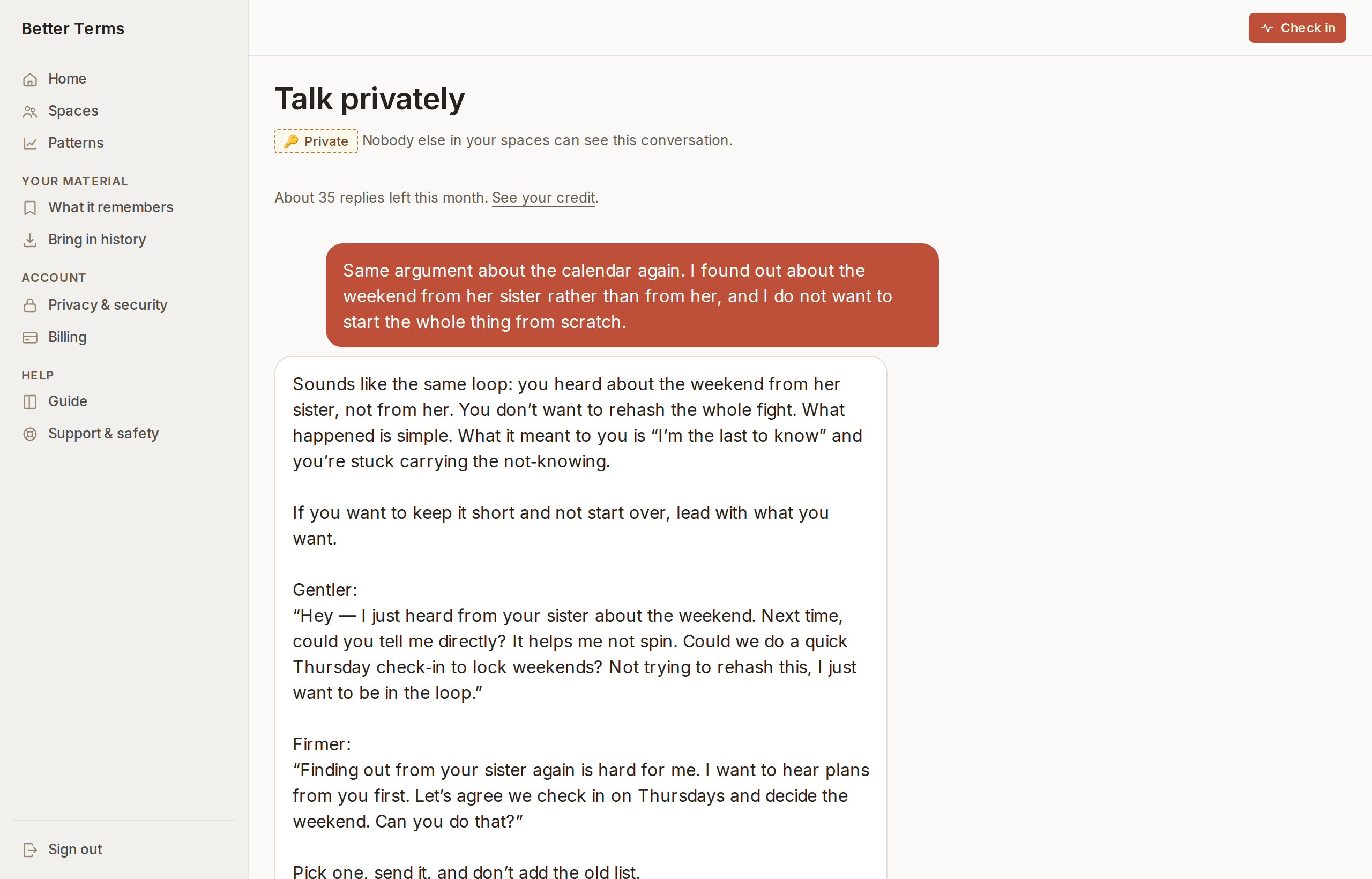
You

Same argument about money again. I don’t want to start from scratch explaining it.

Guide

You don’t have to. In March you said the trigger was being told after the fact rather than the amount. Last time, saying that plainly worked better than waiting for the right moment.
Uses your private contextNot shared with anyone
Private to you. The other person is not told this conversation happened.

Independent Perspectives

Two perspectives. Neither gets to rewrite the other.

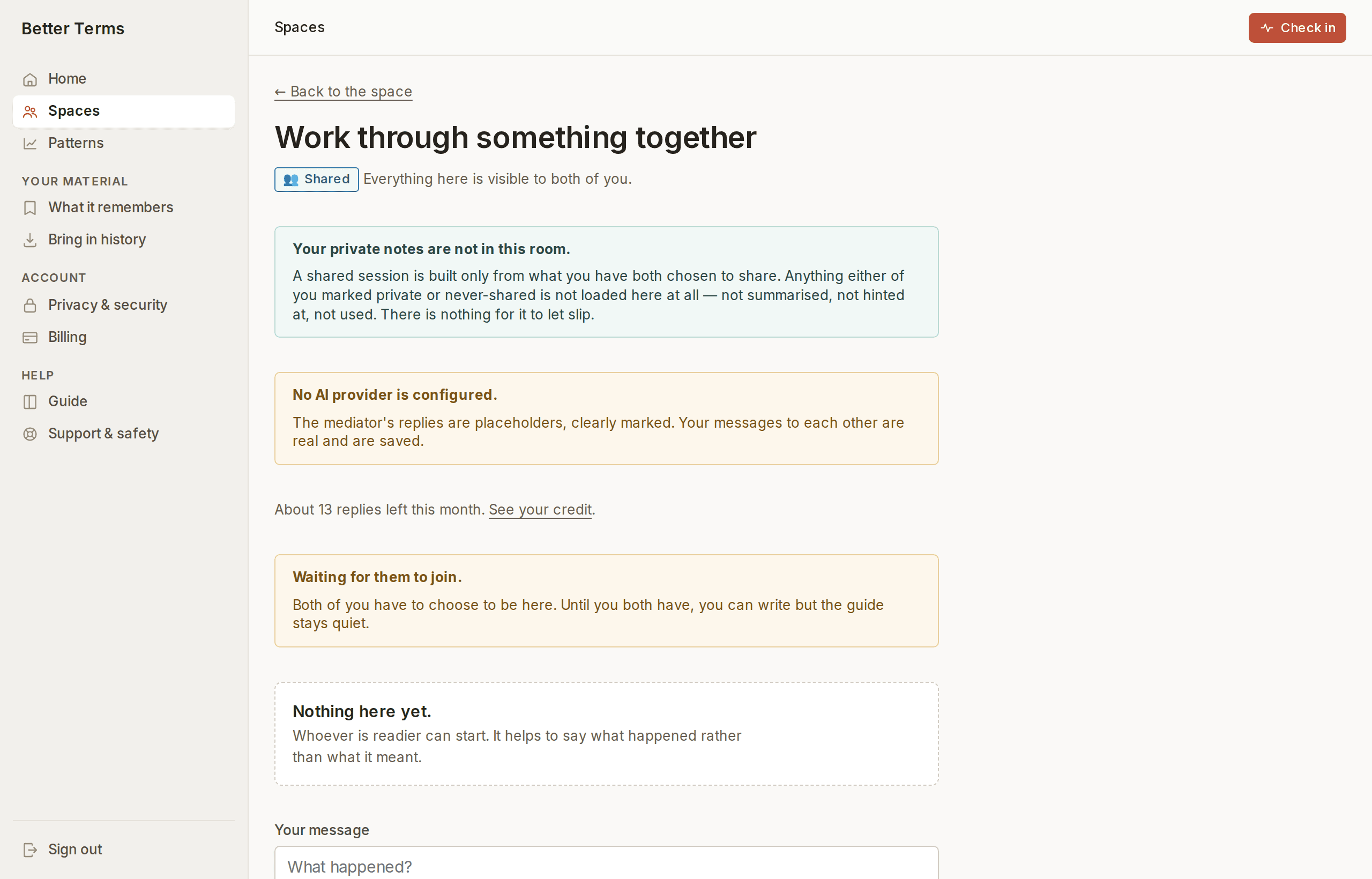
Both accounts are written before either is read. Not as etiquette — the product will not show you theirs until yours is in, because the moment you read their version, your own quietly reorganises itself around it.

You write yours first

I told her the date weeks ago and she booked over it anyway. It felt like it didn’t matter.
They cannot see this yet

They write theirs, unread

He mentioned it once, in passing, in the middle of something else. I had no idea it was fixed.
You cannot see this yet

Then both, at once

  • You agree the date matters and that neither of you wants to cancel.
  • You disagree about what was said, not about what either of you wanted.
  • One thing to settle first: how plans get confirmed, not this plan.
Independent Perspectives

Once both are in, they appear together — and what comes back summarises each position, names the points you already agree on, and separates what is actually disputed from what was simply seen differently.

Two people can remember the same evening differently without either of them lying. Most arguments are that, and treating it as a dispute about facts is what makes them last.

You don’t need to agree on what happened to agree on what happens next.

Some tools will tell you who was right. This one does not score, tally or declare an outcome — not as a policy the model is asked to follow, but because a verdict would just become the next thing to argue about.

Bring your context

You have explained this before. Don’t start over.

Every new chat begins from nothing — who everyone is, what happened in March, what you have already tried. If you have spent months explaining that to ChatGPT, Claude, Gemini or Grok, export it and bring the parts that matter.

  • See every conversation in the file before anything is written.
  • Choose them one at a time, or by date. Nothing is all-or-nothing.
  • It arrives private, and there is no option to import into a space someone else can read.
  • Changed your mind? Undo removes everything that import created.

Works with exported files from ChatGPT, Claude, Gemini and Grok, this product’s own export, or plain text — and reads an unfamiliar export by its shape. Nothing is connected to your accounts.

Preview — 3 of 214 conversations selected
ConversationMessagesStarted
Money conversation prep42Mar 2026
Talking to my sister18Feb 2026
Rewriting my CV96Feb 2026
Holiday planning row11Jan 2026
Nothing is written until you commit. Imported material arrives private.

Privacy you can see

Three levels. You pick one every time you write.

Not a settings page you visited once. The level is on screen while you type, and it decides what the other person can ever see.

SharedShared — the other person can see thisThey can see it.

Used in sessions you do together, and in anything you both look at. This is the only level that ever reaches them.

PrivatePrivate — only you can see thisThey cannot see it.

Yours. Your guide can use it to help you. You can share a specific item later if you decide to, one at a time.

100% privateFully private — never shown to the other personThey cannot see it, or that it exists.

Never quoted, summarised, counted in a total, or hinted at. Excluded from shared figures before they are calculated, not filtered out afterwards.

Private context can shape the advice you get without ever appearing in it — used to steer what your guide suggests to you, never repeated, attributed, or hinted at. How that is enforced in the code.

After two ratings

Before

There are a few things worth sitting with here. It might help to consider what was underneath the reaction, and whether the timing played a part…

You rated this: too long

After

Three options. Say it tonight while it’s fresh, wait until Sunday, or write it down first. Given last month, tonight.
Your preferences are private to you.

Adapts to you

Ratings say what you liked. Outcomes say what helped.

Rate a reply and the next one changes — length, directness, whether it asks questions or hands you options. That is the easy half.

The half that matters comes later. After something has played out you answer a few short questions on your own: did it feel resolved, did you feel heard, what do you want to remember. An approach can be gratefully received and still leave the argument exactly where it was, and only the debrief knows the difference.

It adapts to you rather than being retrained by you — nothing you write changes the underlying model. Your preferences and outcomes are yours, visible on the page that lists everything it remembers, and invisible to anyone you share a space with.

1Context

What you brought, and what you have written since.

2Guidance

Suggestions shaped to how you take them in.

3What you did

The conversation you actually had.

4Outcome

Whether it resolved, and whether you felt heard.

5Next time

More of what worked for you, less of what did not.

Two people, two guides

Your guide never briefs the other person.

You each have your own. It knows your history and what has worked for you, and a session you do together is built by a separate path that cannot read any of it — not a filter that could be misconfigured, a route that never loads it.

How privacy works

One space, two guides

Their guide says

Ask what would make this feel settled, then stop talking. They tend to arrive at it slowly.

Your guide says

Lead with the specific thing, not the pattern. You said last time that starting broad made it feel like an accusation.
Neither guide reveals the other’s private material, or that there was any.
Last 30 days

Check-ins

21

Your average

6.8/ 10

Direction

Trending up

Sunday evenings score lowest, and have done for six weeks.

Private unless you choose to share it.

Private check-ins

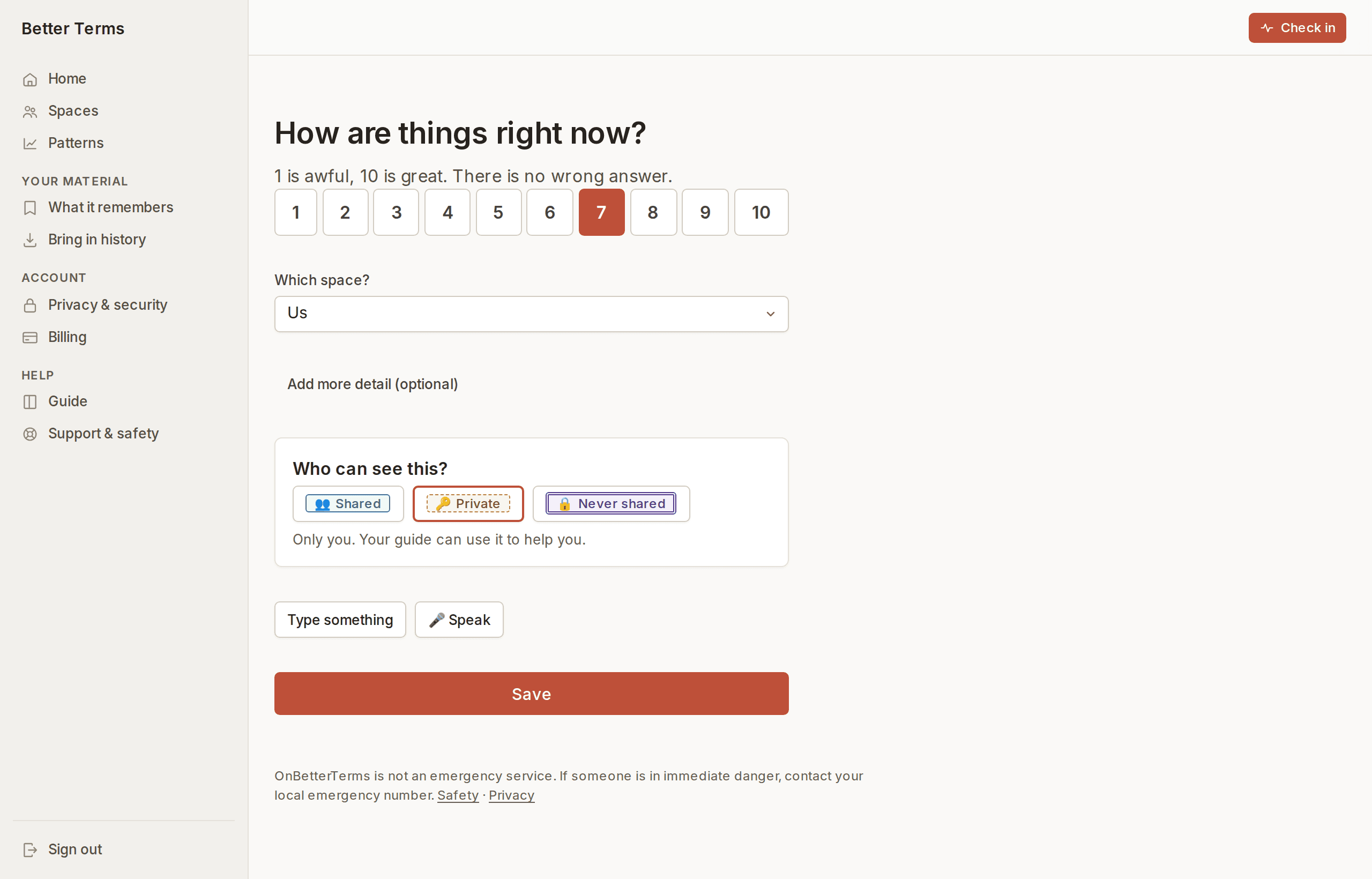
A number and a sentence, when you have ten seconds.

Over weeks this is what turns into something useful: which days are harder, what tends to come before a bad stretch, what has actually improved.

Private unless you say otherwise, and below five check-ins it says there is not enough yet rather than drawing a line. A trend through three points is a picture of nothing.

Why not just use a chat window?

For a one-off question, do. General assistants are good at the question in front of them. What they cannot hold is a second person, a boundary between what you would say out loud and what you would not, and whether last month’s suggestion actually worked.

The honest comparison

Who it is for

Not only couples.

A space holds one relationship. Whether anyone else is in it is up to you.

On your own

Plan a hard conversation, work out what actually bothered you, or keep a private record of how things are going. Nobody has to be invited, ever.

Two people

Partners, but also friends, siblings, co-parents, roommates or business partners. Each of you gets your own private guide, plus sessions built only from what you have both shared.

A household

More than two in one space, for the arrangements that involve everybody — money, chores, visits, who agreed to what. Private stays private for each person in it.

At work

A disagreement with a colleague, or an expectation nobody actually agreed to. A communication tool, not an HR system — nothing is reported to anyone.

Before, during, after

A disagreement has a life longer than the row.

Most of the damage is done before it starts and after it ends — in how it gets raised, and in whether anything actually changed.

Before

Say it however it comes out, pick what you actually want from saying it — to be understood, to set a limit, to reach a decision — and get a version you could send. You edit it, you keep it or you do not, and nothing reaches anybody until you deliberately share that one thing.

The part that works when the other person never joins. Plenty of people only ever use this.

During

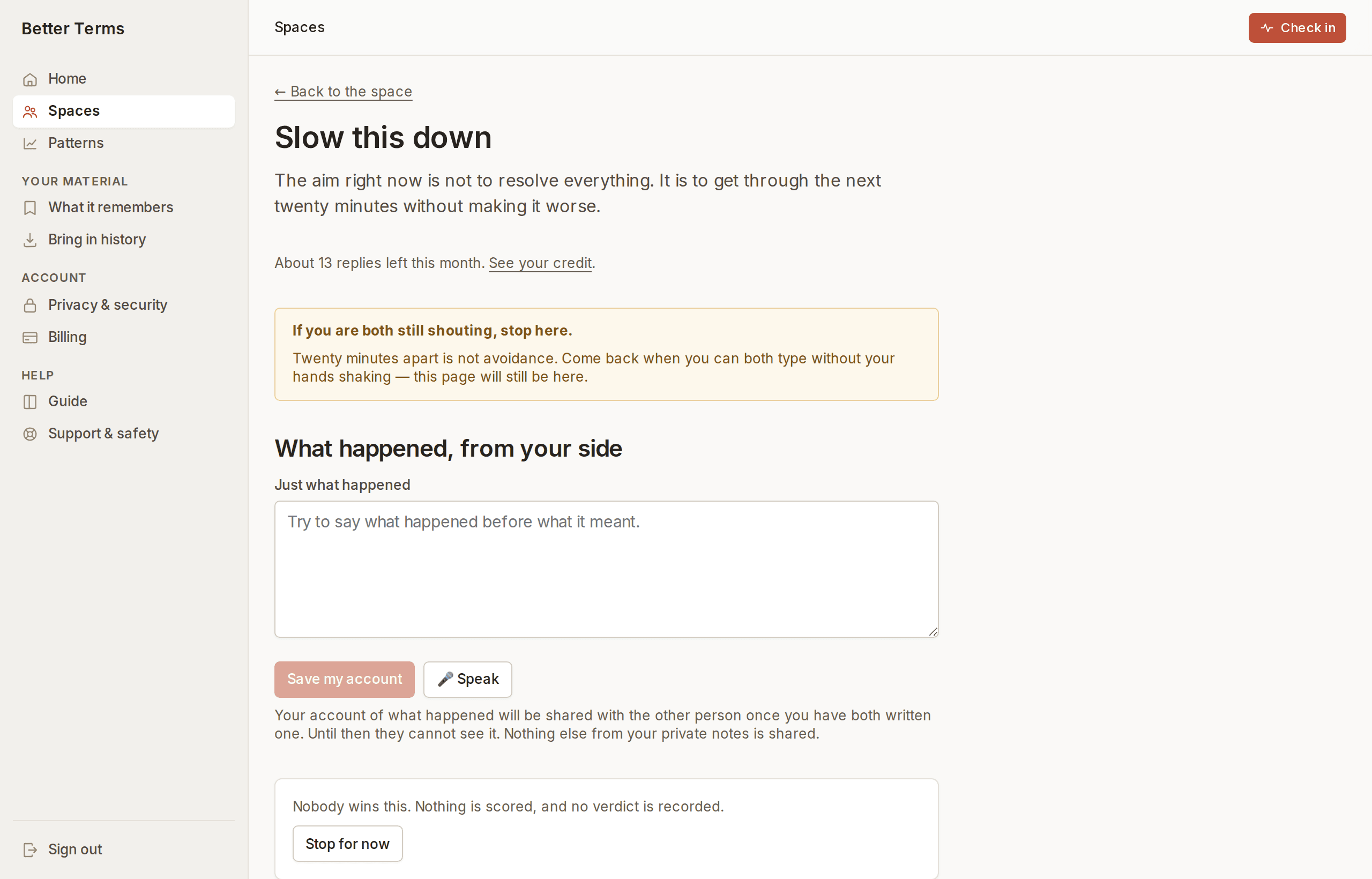
Both accounts first, then one issue at a time with the rest explicitly parked rather than dropped. If it is escalating rather than settling, it says so and stops rather than coaching through it.

After

A short debrief, answered separately — what was actually resolved, what was not, whether you felt heard. Neither of you sees the other’s answers. What you agreed to try can become a goal with a name on it and a date, and a check-in later on whether it held.

Which is the point: the same argument four times is four arguments, unless something between them is different.

What using it looks like

The goal is not to get good at talking to this.

It is to get through the conversation with the person. Nothing here asks you back daily, there is no streak to keep, and a check-in meant to take ten seconds takes ten seconds.

A tool for hard conversations that quietly became the easier place to have them would have failed at the only thing it is for.

Start with whatever you already have.

Free, no card, and you can delete everything — including anything you imported — at any time.

OnBetterTerms — AI for difficult conversations and conflict resolution